
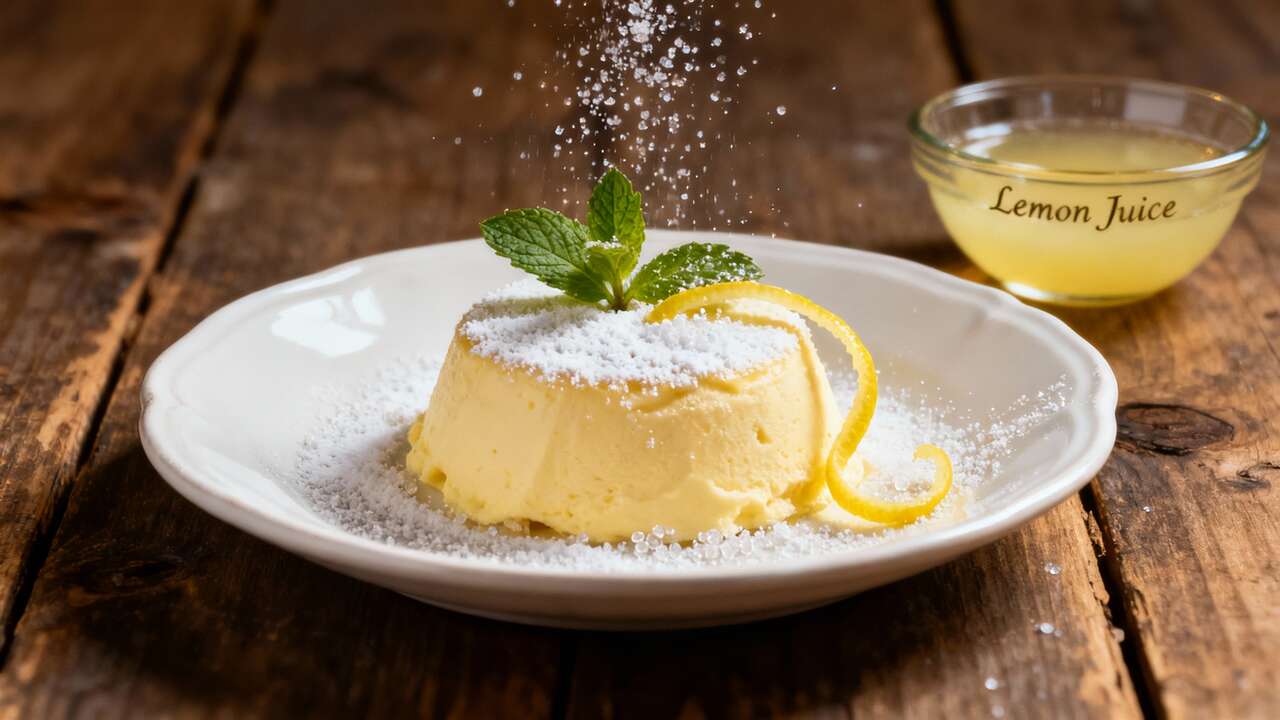

In the vast universe of desserts, some are celebrated for their richness, others for their comforting warmth. This lemon mousse, however, belongs to a different celestial body entirely. It is a study in weightlessness, a culinary creation so impossibly light and airy it feels less like eating a dessert and more like scooping up a citrus-kissed cloud. Forget the dense, heavy puddings of the past. We are about to embark on a journey to create a mousse with a texture that is ethereal, almost effervescent, melting on the tongue in a bright, clean burst of lemon flavor. This isn’t just a recipe; it’s a technique. By mastering the art of the Italian meringue and the gentle science of folding, you will unlock the secret to a dessert that defies gravity. It’s the kind of showstopper that elicits gasps of delight, a perfect, luminous finale to any meal that proves elegance and flavor need not be heavy-handed. Prepare to elevate your dessert game to stratospheric new heights.
35 minutes
10 minutes
moyen
€€
Ingredients
Utensils
Preparation
Step 1
Begin by preparing your stabilizer, the gelatin. This is what will give our cloud-like mousse structure so it doesn’t collapse. In a small bowl, pour 60 ml of the cold water. Gently sprinkle the gelatin powder over the surface of the water. Don’t dump it in all at once, or it will clump. Let it sit undisturbed for about 5 to 10 minutes. You will see it absorb the water and become thick and jelly-like. This essential process is called blooming (the act of soaking gelatin in a cold liquid, which hydrates and softens the granules, allowing them to dissolve smoothly and evenly when heated). Set this aside for later.
Step 2
Now, create the vibrant lemon heart of your mousse. In a small saucepan, combine the bottled lemon juice, the remaining 60 ml of water, and 100 grams of the granulated sugar. Place the saucepan over medium heat, stirring gently just until the sugar has completely dissolved. You don’t want to boil it, just warm it through. Once the sugar is dissolved, remove it from the heat. Add your bloomed gelatin to the warm lemon mixture and stir until the gelatin has completely melted into the liquid. It should be perfectly smooth. Pour this lemon base through a fine-mesh sieve into a large mixing bowl to catch any potential bits of undissolved gelatin. Set this bowl aside to cool to room temperature. This is a very important step; patience is key.
Step 3
While the lemon base cools, we will construct the secret to our mousse’s ethereal texture: a flawless Italian meringue. This meringue is incredibly stable because the egg whites are cooked by the hot sugar syrup. In the clean bowl of your stand mixer, combine the powdered egg whites with the final 60 ml of water, whisking to dissolve. Add the cream of tartar, which helps stabilize the egg whites and allows them to whip up with more volume. In your now-empty small saucepan, combine the remaining 100 grams of sugar with just enough water to make it look like wet sand (about 40-50 ml). Bring this to a boil over medium-high heat, and let it cook without stirring until it reaches 240°F (115°C) on your instant-read thermometer. This is the soft-ball stage. As the syrup approaches the correct temperature, begin whipping your egg white mixture on medium-high speed until they form soft peaks. With the mixer still running, very carefully and slowly stream the hot sugar syrup down the side of the bowl into the whipping egg whites. Be cautious as the syrup is extremely hot. Once all the syrup is added, turn the mixer to high and continue to whip for 5-7 minutes, until the meringue is glossy, stiff, and the outside of the bowl has cooled to room temperature.
Step 4
The final components are almost ready. Check on your heavy cream, which should be very cold straight from the refrigerator. Cold cream whips up much better and holds its shape. Pour the cold UHT heavy cream into a separate, chilled mixing bowl. Using a hand mixer or your cleaned stand mixer, whip the cream on medium-high speed until it holds soft peaks. Soft peaks (a stage in whipping where, when the beaters are lifted, a peak forms but the tip gently droops over) are what we want for a light mousse. If you whip it to stiff peaks, it will be harder to fold in and can result in a heavier, more buttery texture. Be careful not to over-whip.
Step 5
Now for the most delicate and crucial part of the process: the assembly. This is where we combine our three beautiful components while preserving as much air as possible. Your lemon base should be at room temperature by now. Take about one-quarter of your magnificent Italian meringue and stir it into the lemon base. Don’t be too gentle here; the goal of this step is simply to lighten the lemon base, making it easier to incorporate into the rest of the meringue without deflating it. Now, pour this lightened lemon mixture into the bowl with the remaining meringue. This is where you must be gentle. Using a large spatula, begin folding (a technique where you use a spatula to cut vertically through the center of a mixture, scrape along the bottom of the bowl, and bring that mixture up and over the top, repeating while turning the bowl) the two together until they are just combined, with a few streaks remaining.
Step 6
To finish your mousse, add the whipped cream to the lemon-meringue mixture. Add it in two or three separate additions, folding gently after each one. Continue to fold until the mousse is a uniform, pale yellow color and no streaks of cream or meringue remain. The key is to be as gentle as possible. You are trying to keep all those tiny air bubbles you created. Once fully combined, immediately spoon or pipe the mousse into four individual serving glasses or bowls. Cover them with plastic wrap and place them in the refrigerator to chill and set for at least 4 hours, though overnight is even better. This chilling period allows the gelatin to work its magic, firming up the mousse into a sliceable, yet still cloud-like, consistency.

Chef’s tip
The secret to a mousse that doesn’t weep or separate lies in temperature control. Ensure your lemon base has cooled completely to room temperature (around 70°F or 21°C) before you begin folding it into your meringue. If the base is even slightly warm, it will melt the delicate protein structure of the meringue, causing your beautiful, airy creation to deflate and become soupy. Patience during this cooling step is the true mark of a patisserie pro.
A Sip of Sunshine
This vibrant dessert pairs beautifully with a late-harvest Riesling or a Moscato d’Asti, whose gentle sweetness and acidity complement the lemon’s tang. The slight effervescence of the Moscato is particularly delightful, as it mirrors the mousse’s own lightness. For a non-alcoholic option, a sparkling elderflower pressé or a high-quality lemonade infused with a sprig of fresh mint offers a refreshingly elegant counterpoint that won’t overpower the dessert’s delicate flavor.
While the French word ‘mousse’ simply means ‘foam’, the dessert as we know it is a testament to the elegance of classic French patisserie. Its genius lies in capturing air within a stable structure, traditionally using whipped egg whites or cream. Our version uses an Italian meringue, a technique that not only provides incredible volume and a cloud-like texture but also cooks the egg whites with the hot sugar syrup. This results in a much more stable and silky final product compared to a mousse made with a raw French meringue, ensuring your dessert holds its shape beautifully from the first spoonful to the last.
- This Dried Fruit Improves Heart Health, Experts Say - 13 November 2025
- 3 Perennials You Should Divide in Autumn for a Healthier Garden Next Year - 13 November 2025
- This Simple Fruit on the Table Naturally Repels Gnats - 12 November 2025